

After a much-needed, nearly two-year hiatus from the grind, I’m pumped to be hopping back in the saddle to share some winners with you guys in this new era of the UFC. I can’t in good faith rise from the ashes and expect you to line up the credit cards, so I’m going to keep everything as Free.99 for the foreseeable future.
Below are my tracked records up through March 2024, for those new or wondering:
2022 Premium Record: 312-165 (65%) +60.39 units
2023 Premium Record: 269-184 (60%) +48.21 units
2024 YTD Premium Record: 61-39 (61%) +28.95 Units
Those numbers don’t mean much if we can’t turn back on the faucet, so without further ado, let’s dive into the first UFC card of the Paramount+ era.
UFC 324 Preview, Fight Card Breakdown, and Betting Picks
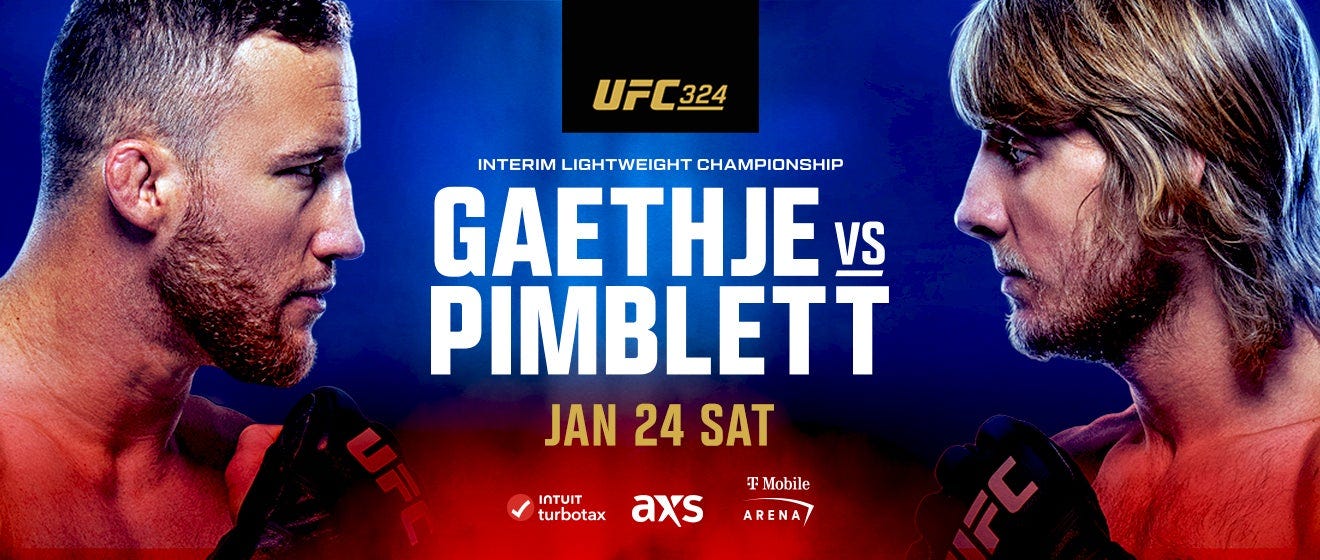
Gaethje vs. Pimblett Headlines the First Paramount+ Era Event
UFC 324 doesn’t just open the UFC’s 2026 calendar — it resets expectations. This weekend’s card marks the promotion’s first numbered event under the Paramount+ streaming partnership, a shift that signals where the business — and the audience — is headed. More importantly, the fight card itself reflects a familiar UFC formula: proven violence at the top, rising equity underneath, and multiple fights that quietly matter more than the odds suggest.
Headlined by Justin Gaethje vs. Paddy Pimblett, UFC 324 blends divisional relevance with betting clarity. There are clean stylistic contrasts, measurable trends, and fewer coin-flip matchups than usual for a card of this size. From a wagering standpoint, this is the kind of event where preparation is rewarded — and blind action gets punished.
UFC 324 Main Card Breakdown and Analysis
Justin Gaethje (+190) vs. Paddy Pimblett (-235) — Interim Lightweight Title
Justin Gaethje remains one of the most pressure-centric fighters in UFC history, with output metrics near 6.5 significant strikes landed per minute and a striking style that forces opponents into high-volume exchanges. He’s absorbed criticism for a “brawl-first” approach, but analytics show his pacing and damage accumulation trend toward winning rounds over time. Even as an older fighter, his strategic leg-kick game and cardio discipline keep him competitive deep into fights.
Paddy Pimblett has been the betting favorite in most of his UFC bouts, and at -235 here he enters with the public and oddsmakers aligned. He offsets Gaethje’s wild pace with efficiency: lower strikes absorbed per minute, creative grappling setups, and a reach advantage that lends positional control. Pimblett’s UFC run (undefeated) emphasizes adaptability over brute force, and that’s part of why his implied odds are so strong. If he disrupts Gaethje’s rhythm early and forces resets, he makes judges’ scorecards much tighter.
Sean O’Malley (-200) vs. Song Yadong (+175) — UFC 324 Bantamweight Co-Main Event
Sean O’Malley’s striking metrics are elite at bantamweight: precise, efficient, and timing-oriented. At -200, he’s the favorite because he consistently controls range and minimizes wasted strikes, forcing opponents into mistakes rather than just out-voluming them. O’Malley’s recent career arc shows his ability to win rounds methodically, a trait correlated statistically with scoring consistency on judges’ cards.
Song Yadong’s path to victory is statistical persistence. With +175 odds, he profiles as a pressure fighter who wins not by explosion but by grinding multi-phase exchanges. His ability to absorb strikes while maintaining output puts pressure on O’Malley’s rhythm, and if Song successfully drags exchanges into the clinch or grappling range, those rounds become tighter than the moneyline suggests.
Waldo Cortes-Acosta (-334) vs. Derrick Lewis (+250) — UFC 324 Heavyweight Bout
Waldo Cortes-Acosta’s -334 moneyline reflects heavy favorite status, and the data justifies it: high strike volume at distance and a finishing rate that leans process over randomness. Heavyweight betting typically involves volatility, but Cortes-Acosta’s discipline reduces variance in pricing.
Derrick Lewis (+250) is the ultimate wild card: one shot ends fights instantly. But outside early exchanges, his defensive inefficiencies and cardio trends favor his opponent stacking points. Bettors who overpay for Lewis’ punch equity without context often find him a poor long-term value.
Natalia Silva (-400) vs. Rose Namajunas (+300) — UFC 324 Flyweight Bout
Natalia Silva’s -400 line signals a clear favorite, justified by her activity metrics and volume differential at flyweight. She pushes pace, mixes striking with grappling transitions, and rarely concedes control phases.
Rose Namajunas remains a high-IQ fighter whose mid-fight adaptability has stolen rounds from superior physical opponents. Her +300 price tag reflects that she can win tactically, but Silvia’s initiative and pressure are correlated with round wins — especially in fights that avoid early finishes.
Arnold Allen (+225) vs. Jean Silva (-275) — UFC 324 Featherweight Bout
Arnold Allen’s +225 underdog line is interesting. His process-oriented striking and defensive acuity put him in many rounds even as an underdog. Jean Silva’s -275 favorite status comes from power and aggression metrics.
If Allen neutralizes early volatility and shifts this into sustained positional scoring, his implied odds may understate his control probability. That said, Silva’s power does justify favorite status here.
UFC 324 Preliminary Card Breakdown and Analysis
Umar Nurmagomedov (-1400) vs. Deiveson Figueiredo (+800)
Umar Nurmagomedov enters this matchup as a significant favorite for a reason: elite grappling control paired with high positional retention metrics. Across his UFC run, Nurmagomedov has posted an 85% takedown success rate in fights where he elected to pursue them, and once grounded, his ability to maintain top control has led to a submission attempt frequency in the top 10% of bantamweights. His recent wins aren’t flashy knockouts; they’re methodical dismantlings of his peers’ offense.
Deiveson Figueiredo complicates the narrative because his finishing rate — particularly via strikes — is among the best in flyweight history. He has nearly a 50% career finish rate and an ability to turn exchanges into sudden outcomes. Metrics show his striking efficiency is high, but he absorbs strikes at a higher rate when pressured, especially against elite grapplers. When fights go past the halfway point, Figueiredo’s output drops faster than his opponent’s, which is exactly where Nurmagomedov’s positional game thrives. This fight poses a classic grappler vs. finisher dilemma, but the current form lines up with measurable control over moments.
Ateba Gautier (-1000) vs. Andrey Pulyaev (+600)
Ateba Gautier’s path to the octagon has been defined by high striking volume and rate of engagement, with ancillary grappling that isn’t elite but suffocates offensive rebalance. In his last four fights, Gautier has averaged 4.8 significant strikes landed per minute while absorbing just 2.1, a differential that translates to steady scoring across all three rounds. His pace creates a landscape where opponents must either fight on his terms or watch rounds slip away on volume alone.
Andrey Pulyaev enters with a more tempered profile. His last two fights show a significant strike landed per minute (SLpM) in the mid-3s, but his defense has proven leaky when pressured. Pulyaev doesn’t generate big power, and his finishing rate is sub-20% across UFC appearances. Bettors evaluating this matchup should note that Gautier’s efficiency in both offense and defensive absorption correlates strongly with fights where he accumulates rounds rather than risks early volatility.
Nikita Krylov (+110) vs. Modestas Bukauskas (-105)
At light heavyweight, Nikita Krylov’s game centers on flexibility: accurate striking, body control, and a submission game that’s become more pronounced in recent years. Across his career, his submission average sits near 1.4 attempts per 15 minutes, and his ability to chain transitions keeps opponents scrambling. Krylov’s recent results indicate increased patience and fewer reckless closes, transforming him into a more effective second-half finisher.
Modestas Bukauskas, despite his power, lacks the consistency metrics that shift lines out of coin-flip territory. His fight-ending striking power is real, but his significant strike differential and takedown defense numbers both lag behind those of his positional peers at this weight. Bukauskas also tends to eat offense during early pressure phases, which plays into Krylov’s hands. This isn’t a mismatch de-facto — Bukauskas can hurt anyone — but the metrics favor the fighter who controls the fight’s geometry rather than relies on punch equity alone.
Alex Perez (-200) vs. Charles Johnson (+170)
Flyweight exchanges trend fast, precise, and unforgiving, and this bout is no exception. Alex Perez’s recent four fights show a consistent strike accuracy near 45% and a takedown success rate north of 50% when he elects to shoot, which gives him multiple avenues to accrue points on scorecards. His endurance metrics also trend strong, with minimal output dropoff into late rounds.
Charles Johnson counters with speed and unpredictability. His striking volume — particularly leg kicks — is among the most efficient in the division, and landing point-scoring strikes against slower counters has been a profitable approach for him historically. However, his defensive metrics show vulnerability under sustained pressure, and Perez’s ability to change levels threatens to neutralize Johnson’s most effective tools. Bettors should recognize this as a balanced fight with clear win conditions for the heavier number.
Michael Johnson (+170) vs. Alexander Hernandez (-200)
This matchup pits veteran experience against emerging explosiveness. Michael Johnson’s career arc has been built on sharp counter-striking and clean defensive footwork, and when he dictates pace, his defensive success rate shoots into the top quintile of lightweight competitors. His output doesn’t overwhelm, but it scores efficiently.
Alexander Hernandez offers a different profile: raw, sudden bursts with power that can end fights early. When Hernandez lands in the first two rounds, his finishing rate climbs above 60%. That said, his cardio metrics suggest diminishing returns if the fight extends deep, and his takedown defense numbers are middling against fighters who maintain distance. From a metrics perspective, this is a “speed/aggression vs. composure/placement” fight with tangible value for bettors who anticipate round progression rather than early fireworks.
Josh Hokit (-200) vs. Denzel Freeman (+170)
Undefeated Josh Hokit brings disciplined output and range control that show up clearly in the numbers: higher significant strike volume (SLpM ~5.1) and lower absorb rate (~2.3). Those metrics correlate strongly with sustained control and favor fighters who avoid chaotic slugfests.
Denzel Freeman’s strength is volume mixed with unpredictability. His grappling attempts per fight are respectable, but his defensive efficiency metrics lag peers at this stage. Freeman creates moments, but Hokit’s structural approach to exchanges suggests he won’t give them away cheaply. Bettors should view this as a fight where control — not occasional bursts — dictates outcomes.
Ricky Turcios (-150) vs. Cameron Smotherman (+130)
Turcios’ trajectory has been upward thanks to controlled pressure and striking accuracy that outpaces Smotherman’s by a measurable margin. His career numbers show significant strike accuracy near 48% and steady control metrics once the fight hits mid rounds.
Cameron Smotherman counters with grit and cage aggression. His forward movement results in higher absorb rates but also more opportunities to land. His finishing rate isn’t elite, and when opponents force positional control, Smotherman’s scoring advantage shrinks quickly. This is a fight where activity pace matters more than power, and Turcios’ precision gives him an edge in both scorecards and tactical positioning.
Adam Fugitt (-250) vs. Ty Miller (+200)
At welterweight, pacing and endurance are the core storylines. Adam Fugitt’s cardio metrics show minimal decay across rounds, making him a strong late-fight accumulator. His strike accuracy sits marginally above Miller’s, and his defense absorbs fewer counter strikes when opposed.
Ty Miller’s resilience and scrambles make him competitive in early transitions, but his output numbers suggest he doesn’t sustain pace as well as Fugitt. Over three rounds, this dynamic often tilts toward the fighter who pushes late rather than the one who relies on early moments. Bettors should note how each competitor handles the middle rounds — that’s where separation tends to happen.
Best UFC 324 Bets (Main Card + Prelims)
1. Justin Gaethje by Decision (+550)
This is a classic price-versus-path bet. Gaethje’s pressure, leg kicks, and sustained output are still elite, and his last several five-round fights show improved round management rather than reckless chaos. Pimblett’s grappling will matter, but unless he secures extended top control, Gaethje is likely to win minutes even while losing moments. Judges tend to reward forward pressure and damage, both of which favor Gaethje over 25 minutes. At this number, you’re buying a realistic outcome at a strong multiplier.
2. Sean O’Malley Moneyline (-205)
O’Malley has the cleanest round-winning profile on the main card outside of the biggest favorites. His distance control, timing, and accuracy consistently frustrate pressure fighters who rely on volume rather than disruption. Song Yadong is tough and durable, but durability alone doesn’t win rounds. If O’Malley avoids prolonged clinch exchanges, this fight trends toward a clear but competitive decision in his favor.
3. Waldo Cortes-Acosta by Decision (+250)
This is a textbook “bet against volatility” heavyweight play. Derrick Lewis is always live early, but Cortes-Acosta’s disciplined pressure, jab-heavy offense, and cardio give him a strong probability edge once the fight settles. He doesn’t chase knockouts, which is exactly what you want against Lewis. If this gets past the first round, the fight strongly favors accumulation and control over punch equity.
4. Umar Nurmagomedov by Submission (+175)
This is one of the clearest prop paths on the entire card. Nurmagomedov’s grappling metrics, takedown success, and positional control point toward sustained top time once the fight hits the mat. Figueiredo is dangerous early, but his defensive grappling has shown cracks against elite control fighters. As rounds progress, Nurmagomedov’s submission chains become more likely, not less.
5. Arnold Allen Moneyline (+215)
This is the underdog spot I like most on the card. Allen’s defensive discipline, range control, and ability to win close rounds make him a strong value against a power-based favorite. Jean Silva can absolutely win early, but Allen’s style is built to neutralize volatility and extend fights into structured exchanges. At plus money, you’re betting on process over explosiveness — a long-term profitable angle.